
Most men don't notice testosterone declining. It doesn't announce itself. It just quietly takes things — your drive, your sleep, your sharpness, the ease with which your body used to feel like yours.
You start waking up tired even after eight hours of sleep. The gym sessions that used to leave you energized start feeling like work you have to drag yourself through. Your mood has a shorter fuse, or maybe no fuse at all — just a flat, low-grade irritability that wasn't there before. Your partner notices something has shifted. You notice it too, but it doesn't feel like a medical problem. It feels like Tuesday.
Here’s what’s important: these changes are real, measurable, and for many men, treatable.
Testosterone doesn’t disappear overnight. It slips gradually — and the right labs can show you what’s actually going on.
KEY TAKEAWAYS
Low testosterone develops gradually and is easy to miss. Its symptoms overlap with other conditions, so labs matter.
“Normal” lab ranges are broad. A full panel gives a clearer picture than total testosterone alone.
TRT can improve libido, body composition, and energy. It also carries real risks that require ongoing monitoring.
TRT is typically long-term, and if you want to preserve fertility, planning needs to happen before you start.
What's Actually Happening in Your Body
Testosterone is produced primarily in the testicles and regulated by signals from the hypothalamus and pituitary gland in the brain. Starting in your 30s, levels taper by roughly 1% per year on average. That’s slow enough that most men don’t feel it for years, but by the 50s and 60s the cumulative drop can matter.
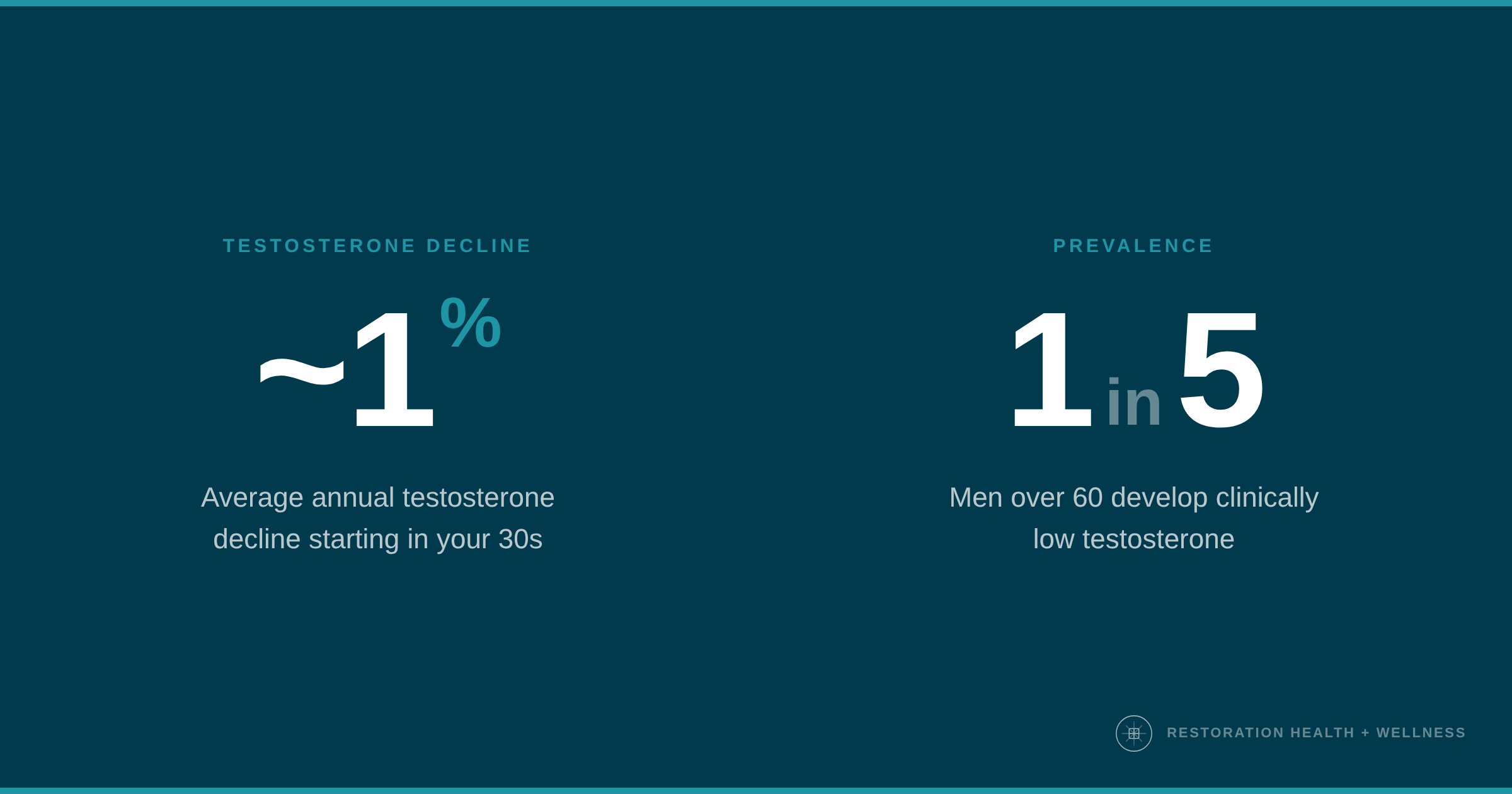
When levels fall too low for your body to function well — a condition called hypogonadism, or “low T” — the effects compound. Energy, mood, libido, muscle, body fat, and bone can all be affected. An estimated one in five men over 60 has clinically low testosterone, and many go undiagnosed for years because the symptoms are easy to blame on stress, aging, or just life.
Several things can push levels down faster than age alone, and many of them are modifiable, which is why we look at them first:
Excess body fat and metabolic syndrome — fat tissue converts testosterone to estrogen
Chronic stress — sustained high cortisol suppresses testosterone production
Poor or short sleep — testosterone rises during sleep, and chronic sleep loss lowers it
Inactivity — sedentary men tend to have lower levels
Alcohol and certain medications — including opioids and long-term steroids
Underlying conditions — such as diabetes, kidney disease, and sleep apnea
What Low T Actually Feels Like
Symptom lists can feel abstract. These are composites of what men tell us at Restoration Health, with details changed to protect privacy:
" I thought I was just getting older. I didn't realize how low my energy had gotten until I started treatment and remembered what it felt like to wake up ready to go."
" My wife said I'd become a different person. Less patient, less present. My testosterone came back and so did I."
" I was working out six days a week and couldn't figure out why my body composition kept getting worse. The answer was in my labs the whole time."
The most common symptoms include:
Persistent fatigue that doesn’t improve with rest
Decreased sex drive and erectile dysfunction
Loss of muscle mass and strength despite consistent training
Increased body fat, especially around the abdomen
Irritability, low mood, or low motivation
Poor sleep quality
Low testosterone can also show up as lower bone density or mild anemia, which usually come to light only on labs.
Many of these symptoms overlap with sleep apnea, depression, thyroid disease, and diabetes. That’s exactly why we look at the full picture before attributing anything to testosterone. If several of them resonate — especially if your bloodwork has come back “normal” — it’s worth a closer look.
The Problem with "Normal" Ranges
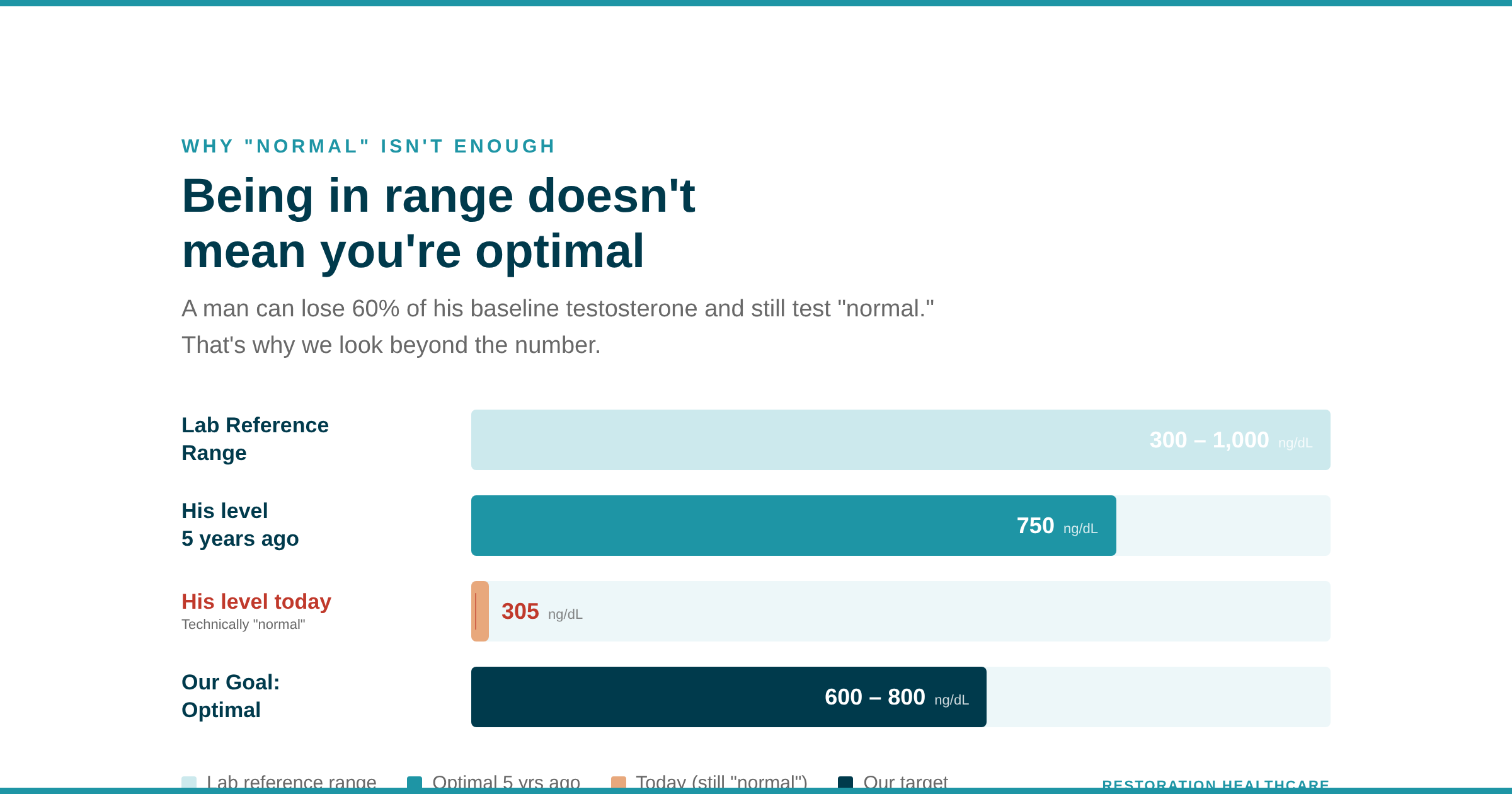
This is where conventional and integrative medicine diverge. Standard lab reference ranges for total testosterone are very broad — often around 300 to 1,000 ng/dL, depending on the lab. A man at 305 is “normal” on paper. But if he was at 750 five years ago, he has lost nearly 60% of his baseline, and he may feel every point of it. He’s technically in range. He’s not well.
At Restoration Health, we also look well beyond total testosterone. A comprehensive evaluation includes:
Total testosterone — the number most providers check
Free and bioavailable testosterone — the portion your body can actually use
SHBG (sex hormone binding globulin) — high levels can lower free T even when total T looks adequate
LH and FSH — pituitary signals that show whether the hormone chain is working
Estradiol — because some testosterone converts to estrogen, and balance matters
Thyroid panel with antibodies, inflammatory markers, and a full metabolic panel — thyroid and metabolic problems can mimic or compound low T
This is the difference between knowing your number and understanding your biology. By “optimal,” we don’t mean as high as possible. We mean the level where you feel and function well and your labs stay safe.
How Testosterone Replacement Therapy Works
Testosterone replacement therapy (TRT) replaces what your body is no longer making in sufficient amounts. Done right, it isn’t about pushing levels above the normal physiological range. It’s about restoring them to where you function well.
Why We Prefer Injectable Testosterone
TRT can be given as injections, topical gels or creams, oral formulations, or implanted pellets. Each has a place, and the right choice depends on the patient. After working with all of them, we prefer injectable testosterone for most men:
Injections allow precise, consistent, adjustable dosing — you know exactly what you’re getting
Topical products can have variable absorption and carry a transfer risk to partners and children
Pellets can’t be adjusted once placed, which makes it harder to fine-tune your levels
Older oral testosterone carries liver risks, and newer oral forms can raise blood pressure, so we generally avoid them
Many men arrive hesitant about injections. What they find is that the needles are small and the process is straightforward to do at home. Weekly or twice-weekly dosing also keeps levels steadier than every-two-week dosing, which can mean a high right after the injection and a dip before the next one.
Types of Injectable Testosterone
The main difference between them is the ester, a molecular attachment that controls how quickly your body absorbs the hormone:
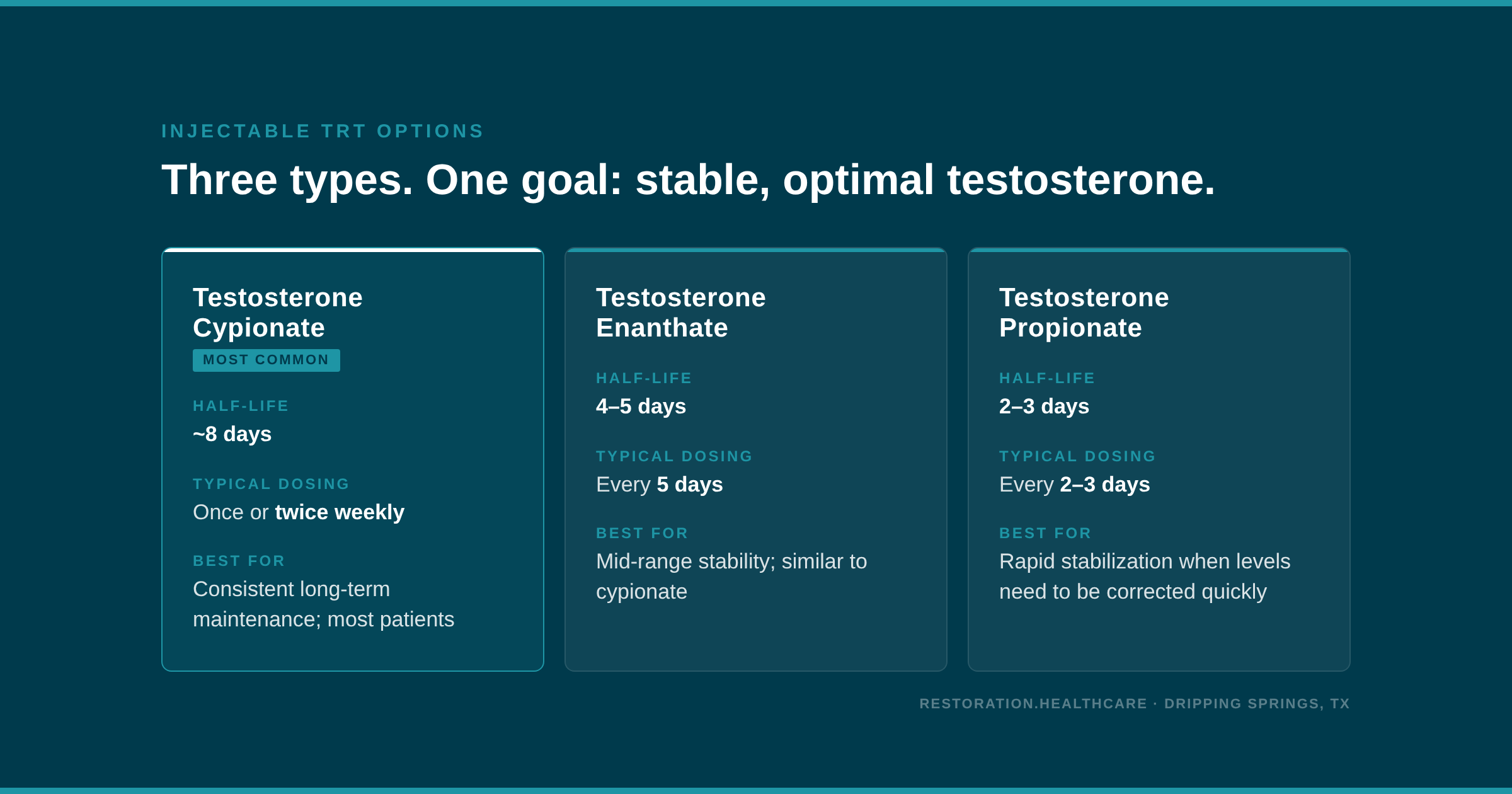
At your consultation, we’ll review your baseline labs, symptoms, and goals to choose the protocol that makes the most sense for you.
What to Expect from TRT
Some changes, such as libido and energy, can appear within weeks. Others, like body composition, build over three to six months or longer. Results vary from man to man, and they’re strongest when low testosterone has been confirmed by labs.
What the research supports well:
Improved libido and sexual desire
More lean muscle and less body fat, especially when combined with resistance training
Better energy and modest improvements in mood for many men
Correction of anemia related to low testosterone
Small gains in bone density
Where the evidence is more mixed:
Erectile function — often improves, especially when low libido is the main issue, but results vary
Sleep — some men sleep better, but TRT can worsen sleep apnea
Fracture prevention — bone density can improve, but TRT hasn’t been shown to prevent fractures
TRT isn’t a cure-all, and it doesn’t replace sleep, nutrition, exercise, and stress management. It works best as one part of a broader plan.
Understanding the Risks — and How We Manage Them
TRT is a medical treatment, and like all medical treatments, it carries risks. Informed consent matters, and so does monitoring. Here is what we watch for:
Elevated red blood cell count (erythrocytosis) — TRT stimulates the bone marrow and can raise hematocrit. We monitor it closely and can adjust the dose or recommend therapeutic phlebotomy.
Blood pressure — testosterone products can raise blood pressure, and FDA labeling now carries a specific warning about it. We check blood pressure regularly, and TRT isn’t recommended for men with uncontrolled hypertension.
Heart rhythm, blood clots, and kidney effects — in the large TRAVERSE trial, men taking testosterone had higher rates of atrial fibrillation, pulmonary embolism, and acute kidney injury than men taking placebo, although absolute rates were low. To lower these risks, we review your personal and family history of blood clots, irregular heart rhythms, and kidney disease before you start. Kidney function is checked with a metabolic panel at baseline and every six months after starting treatment.
Sleep apnea — TRT can worsen it, so we screen for symptoms and address apnea when needed.
Elevated estrogen and gynecomastia — testosterone can convert to estrogen. We track estradiol and adjust your protocol if needed. Caught early, this is usually reversible.
Reduced fertility and testicular shrinkage — TRT suppresses your body’s own signal to the testicles, which lowers sperm production. If you want to preserve fertility, tell us before starting. Other options exist, but they require early planning.
Acne and hair changes — usually manageable with dose adjustment or topical treatment.
Prostate health — we check PSA before starting and monitor it regularly. Large trials have not shown that TRT causes prostate cancer, but men with existing or suspected prostate cancer need careful evaluation first.
A note on heart health: TRAVERSE, a large randomized trial of a testosterone gel in men with hypogonadism and elevated cardiovascular risk, found no increase in major cardiac events compared with placebo, and the FDA has since removed the cardiovascular boxed-warning language from testosterone labels. That’s reassuring, but it isn’t proof that TRT protects the heart, so we keep monitoring cardiovascular risk factors throughout treatment.
How We Monitor Your Treatment
Monitoring isn’t a formality. It’s how TRT stays safe and effective.
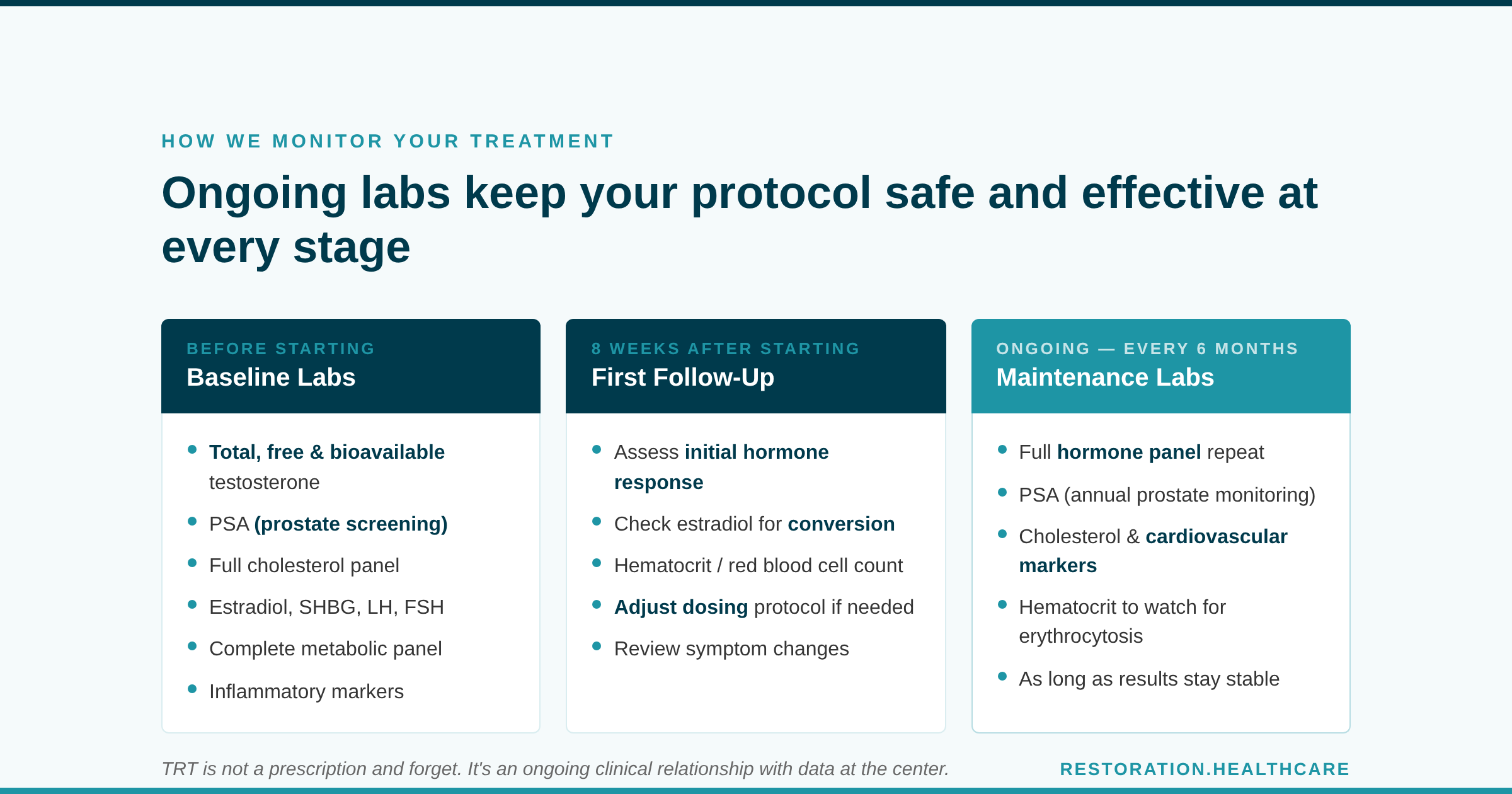
This isn’t a set-it-and-forget-it prescription. It’s an ongoing clinical relationship with data at the center of every decision.
Is TRT Right for You?
TRT is a medical treatment for a confirmed hormonal deficiency. It’s not a lifestyle supplement or a performance enhancer. It’s also typically a long-term commitment: for most men, levels fall again if treatment stops. Good candidates are men who:
Have lab-confirmed low testosterone, with testing that goes beyond total T
Have symptoms consistent with hypogonadism that affect their quality of life
Have been evaluated for reversible contributing factors such as weight, sleep, stress, and medications
Understand the monitoring commitment and are ready to engage with it
Have had appropriate screening, including PSA
TRT isn’t right for everyone. Men with certain cancers, uncontrolled high blood pressure, or untreated severe sleep apnea need to address those first. And if you want to have children, we’ll talk through fertility-preserving protocols before you start.
Common Questions
Do I need to stay on TRT for life?
For most men with confirmed deficiency, yes. Levels typically fall back when treatment stops. If a reversible factor like weight, sleep, or a medication is driving your low T, addressing it may improve your numbers, which is why we look for those first.
How soon will I feel a difference?
Some men notice better energy and libido within several weeks. Changes in body composition and other measures take three to six months or longer.
Find Out Where You Actually Stand
Most men with low testosterone have had labs done before. Most have been told they’re fine. What they haven’t had is a comprehensive evaluation that looks at the full hormonal picture — free testosterone, binding proteins, estrogen, thyroid, and metabolic function — and connects those numbers to what they’re actually experiencing.
That’s what a new patient appointment at Restoration Health is designed to do. Before you arrive, we review your in-depth lab panel: 80+ biomarkers drawn at Quest Diagnostics on your behalf, ready before your first visit. You don’t leave with a promise to follow up. You leave with answers and a plan.
Schedule your new patient appointment at restoration.healthcare, call (512) 200-3240, or email hello@restoration.healthcare. Located at 141 E Mercer St #B, Dripping Springs, TX 78620. Virtual appointments available throughout Texas.
Your biology is specific. Your care plan should be too.
SOURCES
1. Bhasin S, et al. Testosterone therapy in men with hypogonadism: an Endocrine Society clinical practice guideline. J Clin Endocrinol Metab. 2018;103(5):1715–1744.
2. Lincoff AM, et al. Cardiovascular safety of testosterone-replacement therapy (TRAVERSE). N Engl J Med. 2023;389:107–117.
3. U.S. Food and Drug Administration. FDA issues class-wide labeling changes for testosterone products. February 28, 2025. fda.gov.
4. Snyder PJ, et al. Effects of testosterone treatment in older men (Testosterone Trials). N Engl J Med. 2016;374:611–624.
This article is for general education and is not a substitute for individualized medical advice. Testosterone therapy is not right for everyone. Talk with a qualified clinician about your own situation.